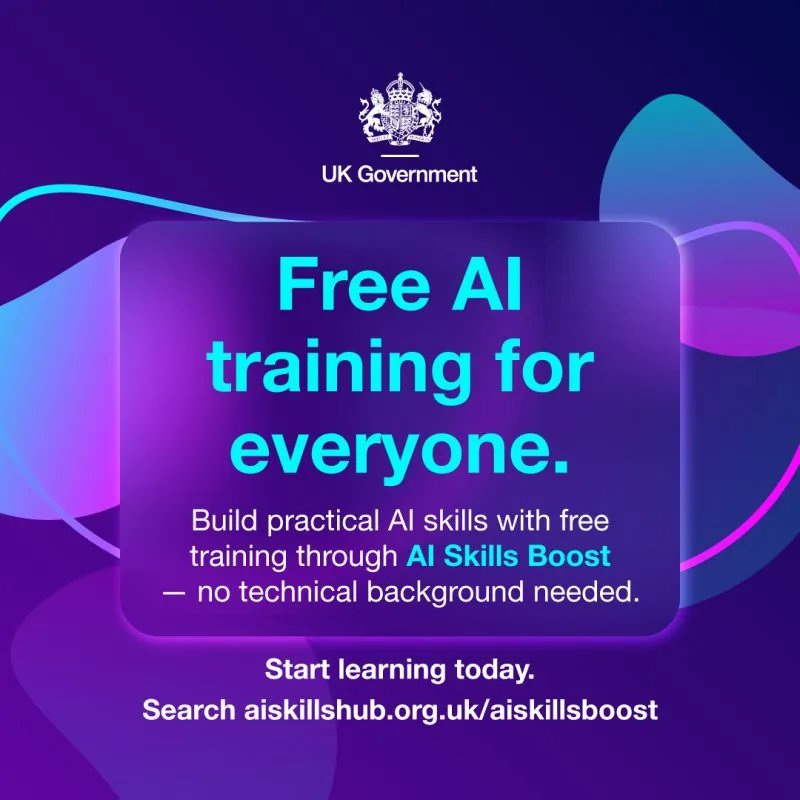
The government will train ten million workers in basic AI skills by 2030. It has already delivered a million course completions since June 2025, some of them in under twenty minutes, through a scheme called AI Skills Boost, run via the government's AI Skills Hub as part of the wider TechFirst programme. Every adult in the UK is eligible, and it costs nothing.
I tell every audience I speak to start there. It is genuinely good, and I am not going to pretend otherwise to make a sales point.
It is built to give ten million people a basic understanding of AI, and at that scale, basic is the right thing to build.
What ten million people actually get
A course built for the whole country has to work for everyone in it: a solicitor in Manchester, a warehouse supervisor in Wigan, a retired teacher trying ChatGPT for the first time. To reach that many people, the content has to sit at the level everyone can follow. That is not a criticism. It is the only honest way to design something for ten million people, and Skills England has done it properly.
What it cannot do is know your business. It was never going to.
The three things a national course cannot see
Nothing built for a country can tell you where your own team is actually struggling. In every business I have trained, someone is quietly stuck on something nobody else has noticed, and a twenty-minute national video was never going to surface it.
Nothing built for a country can tell you what your specific business is liable for. A conveyancer running AI over lease documents and a marketing team drafting social posts carry entirely different risks under UK GDPR and the EU AI Act, and a course written for both of them at once cannot answer for either one specifically.
And nothing built for a country can notice what is happening to the judgement of the people using it. Researchers have a name for the pattern now: cognitive surrender, the point where someone stops checking the AI's answer and starts trusting it by default because checking takes effort and trusting is easier. That does not show up in a course completion certificate. It shows up months later, in a decision nobody in the room can properly explain.
Those three things only get caught in the actual building, with the actual people, on the actual work. That is the part that has to happen locally, because nothing designed for a country ever could.
What we do with the gap
This is the part where I have to be straight about why I am writing this. Safer Haven AI exists specifically to cover what a national course cannot: role-specific enablement that changes how people actually work, risk and compliance built around what your business is actually liable for, and the human side of AI that almost nobody else is talking about. Take the free course first. It is the right foundation. Then get in touch when you are ready to find out what it missed.
Free course done? Here's what it missed.
A 30-minute conversation to find out where your team is actually struggling, what your business is specifically liable for, and what to do about both.
Book a free intro call