
A team doing serious work, asking exactly the right questions about AI.
Browns Case Management support people rebuilding their lives after life changing injury. It is careful, human, deeply personal work, and it runs on some of the most sensitive information there is. Medical histories. Rehabilitation plans. The private details of people at their most vulnerable.
AI was already part of the conversation at Browns. The team were curious, some already exploring what it could offer, and the leadership had a very specific question: with data of this kind, in a sector with these obligations, what does responsible AI use actually look like? That was the right question to be asking.
Sue and the team were not in crisis. They were being proactive. They understood the stakes their work carries, and they wanted the same care in AI that runs through everything else they do. That is the moment they called us.
“We knew AI was relevant to our sector. What we wanted was to approach it the right way.”
We spent over a week inside their world.
We did not arrive with a slide deck and a generic AI talk. We studied how Browns actually work. We mapped their workflows, understood their daily processes, and built a clear picture of exactly where AI could add value and where the data obligations required extra care.
Only then did we feel confident to build something that would land. Something specific to case management, to their obligations, to their people.
This is what most trainers skip.
This is why the results look different.
Three risks hiding in plain sight.
Every business we meet has them. Most have never named them out loud.
Shadow AI
Staff already using unapproved tools, with the best of intentions and none of the guardrails. Invisible to the business, and growing every week.
Special category data
Health and personal records that carry the heaviest obligations under UK data law and the EU AI Act. Exactly the data most likely to end up pasted into a chatbot.
The confidence gap
Some of the team frozen by fear, some moving too fast and trusting outputs they should question. Both ends of that line create risk, and both sit with the business.
Assess. Train. Protect.
The same framework we bring to every client, shaped entirely around Browns.
Assess
We mapped exactly where AI was already in use, which tools touched sensitive data, and where the data obligations required the most attention. Browns had the right instincts. Our job was to give those instincts a structure.
Train
A bespoke, jargon free session built for clinical and admin staff alike. Real prompts, real case management examples, and an honest look at the three ways AI quietly gets things wrong: hallucination, where it states something false with total confidence, bias, where the answer favours one outcome over another, and fabrication, where it invents a source, a quote or a figure that was never real. All three, using our therapy informed SAFER framework.
Protect
Clear rules on what can and cannot go into an AI tool, mapped to their obligations, so the whole team knew where the lines were and why they mattered.
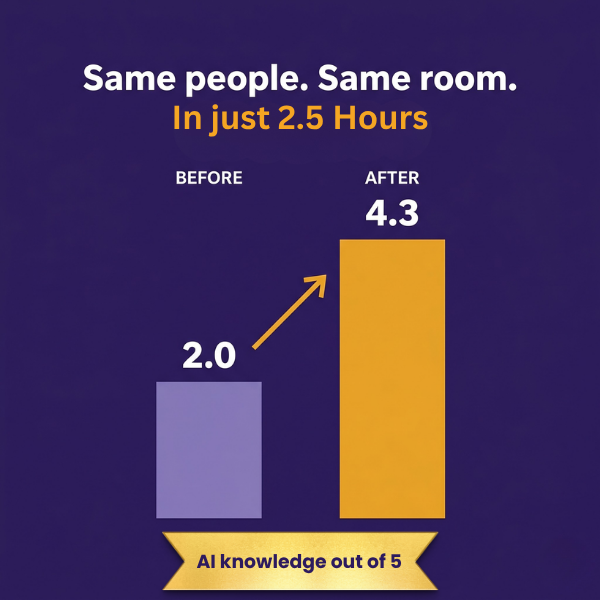
AI knowledge score from 2.0 to 4.3 out of 5. Same people. Same room. 2.5 hours.
Full clarity on AI hallucination, bias and fabrication. The topic most trainers avoid.
Not one person left unconvinced. Zero detractors. Every single attendee.
One participant's one word answer when asked, before we began, how AI made them feel.
Fear with knowledge is protection.
What that same clinical professional took away by the end of one morning.
Fear became confidence.
What does +64 actually mean?
Zero detractors. Not one.

“Pitched at the right level. An incredible experience.”
“Darren created bespoke AI training that perfectly matched what we needed. He engaged the team quickly and kept them focused throughout. Very positive feedback from the rest of my team. I would absolutely recommend him.”
Sue Brown, Director, Browns Case Management.
Fear became fluency.
In a single morning, a team that had been quietly anxious about AI became a team that understood it. They knew what was safe, what was not, and exactly why. The tools they had been half using in the shadows came into the open, with guardrails around them.
The fear did not vanish. It matured into the right kind of caution, the kind that protects a business and its clients. And the curiosity that was already there finally had somewhere safe to go.
Browns did not stop at one session. The relationship continues, because AI does not stand still and neither do their obligations. We watch the horizon so they can keep doing what they do best.
Every programme we build is specific to your sector, your daily functions and your regulatory obligations.
You need something built for you.
(EU AI Act Article 4) Article 4, Regulation (EU) 2024/1689 “Providers and deployers of AI systems shall take measures to ensure, to their best extent, a sufficient level of AI literacy of their staff and other persons dealing with the operation and use of AI systems on their behalf, taking into account their technical knowledge, experience, education and training and the context the AI systems are to be used in, and considering the persons or groups of persons on whom the AI systems are to be used.” EU Artificial Intelligence Act, Official Journal, 13 June 2024. Wording currently in force; a Digital Omnibus amendment softening this obligation is expected in the Official Journal before 2 August 2026.